Biography
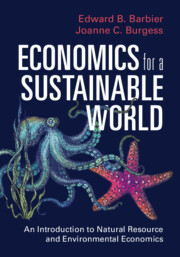
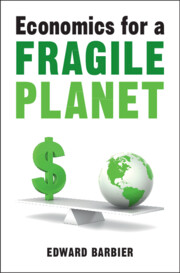
Dr. Edward Barbier is a University Distinguished Professor in the Department of Economics, Colorado State University, a Senior Scholar in CSU s School of Sustainable Futures, a member of the US National Academy of Sciences, and a Visiting Professor at the Grantham Research Institute for Climate and the Environment, London School of Economics and Political Science. He is also a Fellow of the Association of Environmental and Resource Economists and an Aldo Leopold Leadership Fellow. Among his honors and awards is the Blue Planet Prize, the Planet Earth Award and the Mazzotti Prize (Italy) for contributions to economics and ecology. Professor Barbier has also been named by Cambridge University as one of the world's 50 most influential thinkers on sustainability.Professor Barbier has published widely in leading academic journals and is a highly cited scholar on economy, nature and sustainability (see Google Scholar, ScholarGPS and AD Scientific Index). He has authored over 350 peer-reviewed journal articles and book chapters, written or edited 27 books, and published in popular journals and social media. He authored the UN's Global Green New Deal, for which he is world renowned. His most recent books include The Water Paradox: Overcoming the Global Crisis in Water Management (Yale University Press, 2019), Natural Resources and Economic Development (Cambridge University Press, 2019, 2nd ed.), Economics of the SDGs: Putting the Sustainable Development Goals into Practice (with Joanne Burgess, Palgrave Macmillan, 2021), and Economics for a Fragile Planet (Cambridge University Press, 2022), which was Winner of the 2022 Choice Outstanding Academic Titles. He has also published a textbook, Economics for a Sustainable World: An Introduction to Natural Resource and Environmental Economics (with Joanne Burgess, Cambridge University Press, 2025).
Professor Barbier previously held positions at University of Wyoming, University of York and the International Institute of Environment and Development, and he was a Visiting Fellow at the Oxford Martin School, University of Oxford. He has also consulted for a variety of national, international and non-governmental agencies, including many UN organizations, the World Bank and the OECD.